
Interviewing
Interviewing
Interviews are your final opportunity to convey your skills and experience to an employer. It is important to prepare in advance in order to present the most thoughtful and polished version of yourself. Think of this not as a passive situation where you’ll react to whatever is asked, but a chance for you to share examples and stories that demonstrate your qualifications.
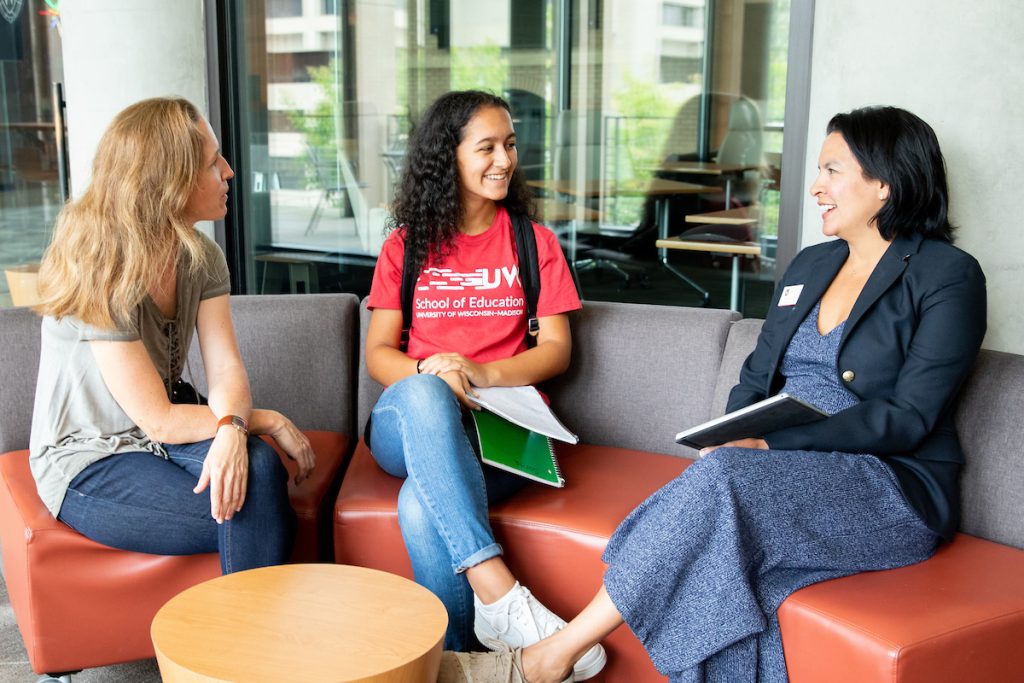
Meet with an Advisor
We offer personalized support in 1:1 in-person or virtual appointments to help students explore career opportunities, practice interview skills, and achieve their goals.
- Career and internship advising.
- Resume, cover letter, and application support.
- Interview preparation and mock interviews.
- Job search, networking, and career exploration resources.
Big Interview
Big Interview is an online interview preparation platform that can help you build confidence through mock interviews, personalized feedback, and practice questions tailored to specific industries and roles. You can use Big Interview to strengthen your interviewing skills, refine your responses, and prepare for internships, student teaching placements, and full-time career opportunities.
UW–Madison students can sign up for free!
Interview Preparation
Know Yourself
To do well in an interview, you should be able to clearly explain your education, experience, skills, and strengths. This helps employers understand why you are a strong candidate for the role and whether you would be successful in the position. It’s also important to know what you’re looking for in a job so you can ask thoughtful questions and decide if the opportunity is a good fit for you.
Know the Position
Review the job description. It contains key information about the role and can help you prepare for interview questions about the position’s responsibilities and required skills. Think about what you’d like to learn beyond what’s listed in the description so you can come prepared with questions that help you better understand the role and organization.
Know the Employer
Collect as much information as you can about the employer from:
- People who work in the field (family, friends, professors, other connections)
- Content from their website
- Information from outside resources like Glassdoor, LinkedIn, or Handshake
Here are some things to look for:
- Positions and career paths (how could you move up?)
- Organization history and structure
- Salary ranges and management styles
- Work environment, culture, and mission
- Future plans and goals
Interview Formats
Interviews can look different depending on the position, field, or stage in the interview process.
Below are some explanations of the different interview formats and some tips to prepare:
What it entails: Asynchronous interviews, also known as one-way or pre-recorded interviews, involve candidates recording their responses to predetermined questions without real-time interaction with an interviewer.
How to prepare:
- Test your recording equipment and ensure a quiet environment.
- Review the questions and practice your responses.
- Maintain a conversational tone in your recorded answers.
- Dress professionally as you would for a traditional interview.
- Check for technical issues before submitting your responses.
What it entails: Virtual interviews are conducted remotely through video conferencing platforms like Zoom or Microsoft Teams.
How to prepare:
- Test your technology and internet connection beforehand.
- Choose a quiet, well-lit space for the interview.
- Dress professionally, even if only the top half is visible.
- Maintain eye contact by looking into the camera.
- Minimize distractions in your environment.
What it entails: Screening interviews are often the initial phase of the hiring process. They are conducted to assess basic qualifications and suitability for the position. They are often shorter than final-round interviews.
How to prepare:
- Know your resume well and be ready to discuss your experiences.
- Highlight relevant skills and achievements.
- Research common questions for the specific industry.
- Showcase enthusiasm and interest in the role.
- Be prepared for behavioral questions.
What it entails: Final-round interviews typically involve meeting with senior leaders in the organization or multiple team members. They aim to make the final decision on the candidate.
How to prepare:
- Review previous interview feedback.
- Be ready to discuss in-depth details about your experiences.
- Showcase your understanding of the company culture.
- Prepare for more complex and scenario-based questions.
- Emphasize how your skills align with the company’s goals.
What it entails: Group interviews involve multiple candidates being assessed simultaneously, often through group activities or discussions.
How to prepare:
- Be a good collaborator while showcasing individual strengths.
- Listen actively to others and contribute thoughtfully.
- Maintain a balance between assertiveness and collaboration.
- Showcase leadership skills if the opportunity arises.
- Stay positive and engaged throughout.
What it entails: Phone interviews involve employers calling to do a pre-screening before offering a second interview.
How to prepare:
- Make sure your phone is not on silent so you hear the call.
- Choose a quiet, non-distracting pace.
- Smile when you can – they might not be able to see you, but when you can offer a warm or excited tone, they will be able to hear your enthusiasm for the role.
- Dress professionally if you think it will put you in the right headspace to be confident when answering!
- Be careful not to cut off the interviewer. It can be more challenging in a phone interview to tell when the other person is done talking.
- Make sure your voicemail is set up and is appropriate, in case you miss the call and need to call back.
Informational interviewing is a great way to learn about careers by connecting with professionals and asking questions about their experiences, roles, and industries. These conversations can provide valuable insights, expand professional networks, and help individuals make more informed decisions about their career and educational goals.
Questions to ask in an informational interview:
- What are your duties and responsibilities?
- What was your undergraduate/graduate major?
- Describe a typical day.
- What do you like most about your job? Least about your job?
- What are your most recent successes on the job?
- How much time do you spend at work? What are your work hours during peak times?
- Can you leave your job behind after work, or is it the kind of job you take home with you?
- What type of people do you interact with?
- What parts of your job are most challenging?
- If you would have done anything differently in your preparation for this career, what would it have been?
- What is the overall philosophy of management in this organization? How is it implemented?
- What are the short range goals of this organization? Long range?
- How are these goals measured? Formally/Informally? How often?
- How hierarchical is the company? When was the last time you interacted with top executives?
- Is there in-house training or opportunities for continuing development?
- Does this company utilize co-ops/interns? Could you suggest any temporary, part-time, or summer work experience that would help a person prepare for your occupation?
- Where or how are job openings communicated within the organization? the career field?
- What is the typical career path in your field?
- What is your educational background?
- What courses were most helpful to you and which would you recommend?
- What steps did you take to enter this career field?
- What training/skills are required for someone who wanted to enter this field now? What training/skills are recommended?
- What are the beginning, average, and top salaries in this occupation?
- What are the trends in this field? What are the trends within specific geographic locations?
- What changes have impacted your field in the last five years?
- Will there be a continued demand for this occupation? How secure will employment be in the future?
- What are the latest developments in your field?
- Are there any special problems, concerns, or challenges of which a person should be aware when considering this occupation?
- What other occupations are closely related to this one?
- What other advice or information can you give a person considering/preparing for this career?
- Can you recommend three suggestions to enhance my marketability for the career field, for location, and /or general employment?
- Are you willing to review my résumé and provide feedback?
- Can you give me the names of three other people who share your enthusiasm for this kind of work? How can I contact them? May I use your name when contacting them?
- May I stay in touch with you and let you know of my decision?
- Do you have any additional advice to help me prepare?

Interview Questions and Strategies
There are many questions that could be asked during an interview, here are some of the most common ones and some strategies to help frame your answers:
See our page on Common Interview Questions for more!
Most interviews will start with this or some similar wording of it. It’s beneficial for you to have an answer prepared, since it will help you begin the interview feeling prepared. But what do you say to this? Where do you start and what should you include? You can structure your response using the Present, Past, Future model below to keep it concise and detailed.
Present: where are you now? | Past: Where have you been? | Future: Where are you going? |
| Consider your major, current job(s), projects, activities, etc. | Consider your past activities, jobs, experiences that have led here | Consider your career interests, goals, and aspirations. |
Example: I’m currently studying Education Studies at UW–Madison and work part-time as a research assistant. I’ve completed an internship with a local state representative and was able to support their work on education policy. This helped me realize that I would like to work in government, where I can do work that promotes equitable opportunity for all students in our educational systems.
Interviewers want to hear about your experience and many questions will ask you to tell them a story about when you’ve previously used a skill that is important to this position. Some common behavior questions like these include:
- Tell me about a time when you worked with a difficult colleague.
- Describe a situation where you had to manage multiple priorities at the same time.
- How have you handled a situation where you had to make a difficult decision at work?
To answer these questions, we recommend using the STAR method to keep your response focused and concise.
The STAR Method is:
- Situation: Describe the context or situation you were in.
- Task: Explain the specific task or goal you needed to accomplish.
- Action: Outline the actions you took to address the situation or task.
- Result: Summarize the outcome of your actions and any lessons learned.
There are things that employers in the United States are not legally allowed to ask you in an interview. It’s important to know your rights and that they cannot ask about:
- National Origin/Citizenship
- Marital/Family Status
- Clubs or Social Organizations not relevant to the job
- Disabilities (unless they relate to the ability to perform the job; see Americans with Disabilities Act)
- Age
- Sexual Orientation/Gender
- Personal information (ex. Height and weight)
- Arrest record (unless related to the job)
When you interview for a job, your prospective employer will ask questions; on the job application, in the interview, and/or during the testing process related to the job.
Federal, state, and local laws prohibit discrimination in employment based on certain characteristics protected by law, such as race, sex, disability, age, and so on, however, many of these laws do not ban specific interview questions.
The focus of interview questions should be: What does the employer need to know to decide whether you can perform the functions of the job?
If asked an improper question, you have a few options:
- You are free to answer the question. However, keep in mind that if you provide this information, you may jeopardize your chances of getting hired, in the event you provide the “wrong” answer. There may be a legal recourse available to you, but this is not the preferred outcome for most job applicants.
- You can refuse to answer the question. Unfortunately, depending on how the refusal is phrased, you run the risk of appearing uncooperative or confrontational, and losing the job. Again, there may be legal recourse, but this is hardly an ideal situation.
- You can examine the question for its intent and respond with an answer as it might apply to the job. For example, if the interviewer asks, “Are you a U.S. citizen?” or “What country are you from?,” you have been asked an improper question. You could respond, however, with “I am authorized to work in the United States.” Similarly, if the interviewer asks, “Who is going to take care of your children when you have to travel for the job?” your answer could be, “I can meet the travel and work schedule that this job requires.”
Following is a synopsis of various federal laws that prohibit discrimination in employment, with examples of improper questions and the questions employers may ask. You can use your answer to the “proper questions” to answer an improper question.
Courtesy of the National Association of Colleges and Employers.
Questions to Ask the Employer
Usually the final 10-15 minutes of an interview will be a space for you to ask questions. Remember, you are interviewing them too. Try to have at least five prepared before you go into the interview. The best questions are the ones you genuinely want to know and still need clarity on after reviewing the job description.
Here are some examples if you need help getting started
What are the next steps in this hiring process?
What are the opportunities for professional development in your organization?
What do you enjoy about working here?
What are the organization’s goals for the coming year?
How is an employee evaluated in your organization?
How does your organization celebrate the success of its employees?
Try to avoid questions like the following:
Can you tell me about your training program? – This is a bit general and you could likely find this information out online.
What would my starting salary offer be? – You should already have an idea from the job description; salary-talk should generally be discussed once an offer is made.
What does your benefits package include? – This is a very generic question; there are a few exceptions to asking about benefits, but generally you can find this information elsewhere or wait until an offer is made.
Closed ended questions – yes or no questions
Interview Tips
- Know the Details: location, length and number of interviews, type of interview (one-on-one, panel, in-person, virtual), and try to arrive 10-15 minutes early to get settled in an counter any possible challenges (parking, traffic, etc.) that may surprise you.
- Dress Appropriately: It’s better to be overdressed rather than underdressed. Wear clothing that is appropriate for the organization for which you are interviewing so that you can convey an image of professionalism and confidence. However, don’t compromise your identity through your clothing or how you present yourself; be authentic and be yourself. Here are some visual examples.
- Body Language Matters: Maintain appropriate eye contact during the interview. Make sure you are sitting up straight, but you don’t have to be stiff.
- Be a Good Listener: Answer the questions they are asking; if you’re unsure of what was asked, it’s okay to ask to clarify or rephrase it again in other words. If you are caught off guard for an answer, pause and think – you don’t have to answer immediately. Think of the interview as a conversation.
- Bring the Essentials: notepad, pen, copy of application materials (resume and cover letter)
- Keep in mind: UW–Madison has a Recruiting Activity Expectations for Students policy that you should review.
After the Interview

Reflect on Your Experience
What went well? What could have gone better? If you can, write your thoughts down soon after your interview has ended so that you can review it later. This way you can use this experience to prepare for the next interview.

Withdraw if Necessary
If you are no longer interested in the position, it is a professional courtesy to inform the employer of your decision to withdraw from the process. This can be done in a quick email to the contact person thanking them for their time and opportunity.
Before you withdraw, you can reach out to the Career Center for advice and guidance. Please be aware UW–Madison has a Recruiting Activity Expectations for Students policy that you should review.

Write a Thank-you Email
Following up with a quick email or handwritten note is never a bad practice. Doing so can help reaffirm your interest, qualifications, and relationship-building skills. It’s best to do this within a day of your interview.