
Evaluating & Negotiating Offers
Evaluating & Negotiating Offers
Evaluating and negotiating job offers begins once a verbal offer for a position has been made and should be done based on thorough analysis of information available to you. While you analyze the information, you will need to consider your values, needs, and economic factors.
Meet with an Advisor
We offer personalized support in 1:1 in-person or virtual appointments to help students explore career opportunities, practice interview skills, and achieve their goals.
- Career and internship advising.
- Resume, cover letter, and application support.
- Interview preparation and mock interviews.
- Job search, networking, and career exploration resources.
Evaluating Offers

Receive an Offer:
Upon receiving the offer, express your appreciation for the opportunity and ask about when the employer expects a decision. Accepting the offer on the spot is not advised to allow for processing time.
Make an appointment with your Career & Internship Advisor to discuss the offer in detail.

Review the Offer:
Gather all pertinent information to inform your decision from a variety of sources.
- Review the terms of your offer, being mindful of your non-negotiables and elements of the experience that will set you up for success.
- Evaluate the information gathered using a Decision Making Matrix. Use the blank fields to identify questions to pose to each organization.

Consider the Timeline:
Determine if an extension on a decision deadline is needed. This may be helpful if you are continuing to interview for other positions. If so, connect with the organization’s HR department or the individual who offered you the position to explore the possibility of more time.
It is often best to email the point of contact and ask to speak about the offer. Trying to negotiate terms of employment, including timeline, via email is not advisable. The earlier this request is made, the better.
Helpful Tools to Evaluate Offers
HR: ask to be connected to people at the organization to learn more
Personal connections who did/do work there
Career & Internship Advisor
UW alumni working there
What Can I Negotiate?
Usually Negotiable
- Offer deadline
- Start date
- Salary
- Signing bonus
- Relocation expenses
Sometimes Negotiable
- Telecommuting
- Position title
- Position location
- Performance review timing/frequency
- Non-compete agreements timeframe
Usually Non-negotiable
- Key duties of the role
- Vacation
- Health insurance
- Retirement savings plan
- Non-disclosure agreements
- Other benefits that apply to all employees
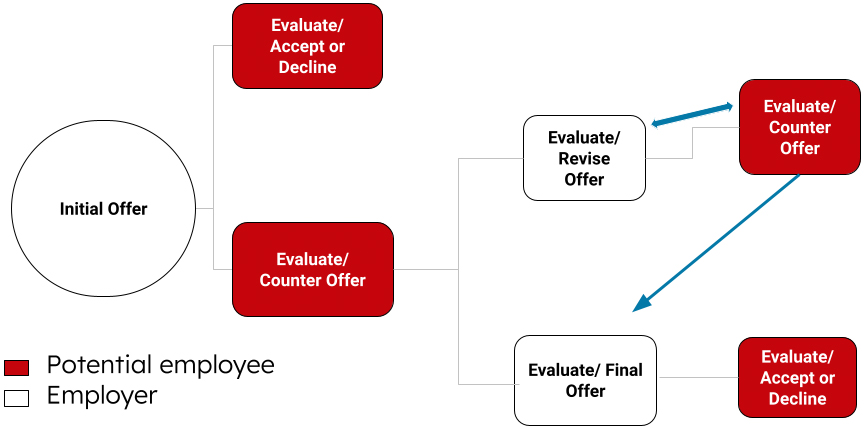
Negotiating Offers
Get organized:
Talk with your advisor, review the offer in detail, conduct additional research on the opportunity/organization, and generate a list of questions/items you wish to negotiate. Ideally, you would discuss all of these items in one conversation. Organize your justification talking points for each.
Request a conversation:
Send an email to the HR or hiring manager point of contact requesting a 20-30 minute to discuss the offer in more detail. Do not try to negotiate items via email as it is much easier for an answer to be a clear “no” if discussion around the why is not feasible.
Prepare for the conversation:
Who will you be speaking with and what information would help them support you in your requests? Be prepared to utilize data/facts from your research to justify your talking points. Anticipate tough questions they may ask (who else are you interviewing with? what could I do to improve this offer so that you will accept it now?)
Open, negotiate, show appreciation:
Show gratitude for the offer and express your interest in the role. Articulate the items that you are curious to learn more about or that are coming up as barriers to you accepting at this time. Avoid making demands, and negotiate the items that matter most to you; getting caught up in minutiae can be unhelpful and frustrating to both parties.
Accept or decline promptly:
Once the negotiations are complete, make a decision in accordance with agreed upon decision deadlines.
What Should I Consider When Evaluating My Offer(s)?
Role:
- What impact will I be able to make in this role?
- What will I be doing in this position?
- What opportunities are there for advancement?
- What access will I have to mentorship, leaders and management?
- Who will my clients be?


Organizational Culture:
- How is great work rewarded or recognized?
- Does the mission of this organization align with my values and goals?
- Do the people and systems within this organization make me feel seen, heard or included?
- Is the location of this opportunity of interest to me?
- What would work/life balance look like here? What hours would I be expected to work?
Compensation & Benefits:
- What does vacation, sick leave, holiday and/or family time consist of?
- Are the base salary, bonuses (if available), and related financial perks such as stock options competitive?
- Will the organization invest in my continued education and learning?
- What benefits are available? Consider healthcare, retirement, profit sharing, pre-tax dollar benefits
- Is this a flexible workplace where hybrid or remote work is permitted?

Accepting or Declining Offers
- Express your desire to accept the position
- Review and sign any formal acceptance documentation
- Complete background checks or additional steps to finalize your hiring
- Communicate with other organizations you are in process with that you have accepted another position. Show appreciation for the time they spent considering your candidacy, and it is okay to stay connected with them as part of your professional network for future opportunities.
- Stop interviewing with other organizations. It is considered unethical to make a commitment and continue seeking other opportunities.
- Build connections with other employees within the organization you will be joining to build your support system and enter the position and organization with confidence.
- Report your acceptance to the School of Education Career Center, and share your new position on LinkedIn!

Tips and Reminders:
- Take time to think through a job offer; do not accept on the spot.
- Be clear on all the factors that make up the offer.
- Research the salaries and benefits.
- Your network is a resource.
- Declining an offer is an option.
- Once you commit, commit fully.
- Get the offer and what is negotiated in writing.
- Be patient, respectful, and courteous throughout the process.